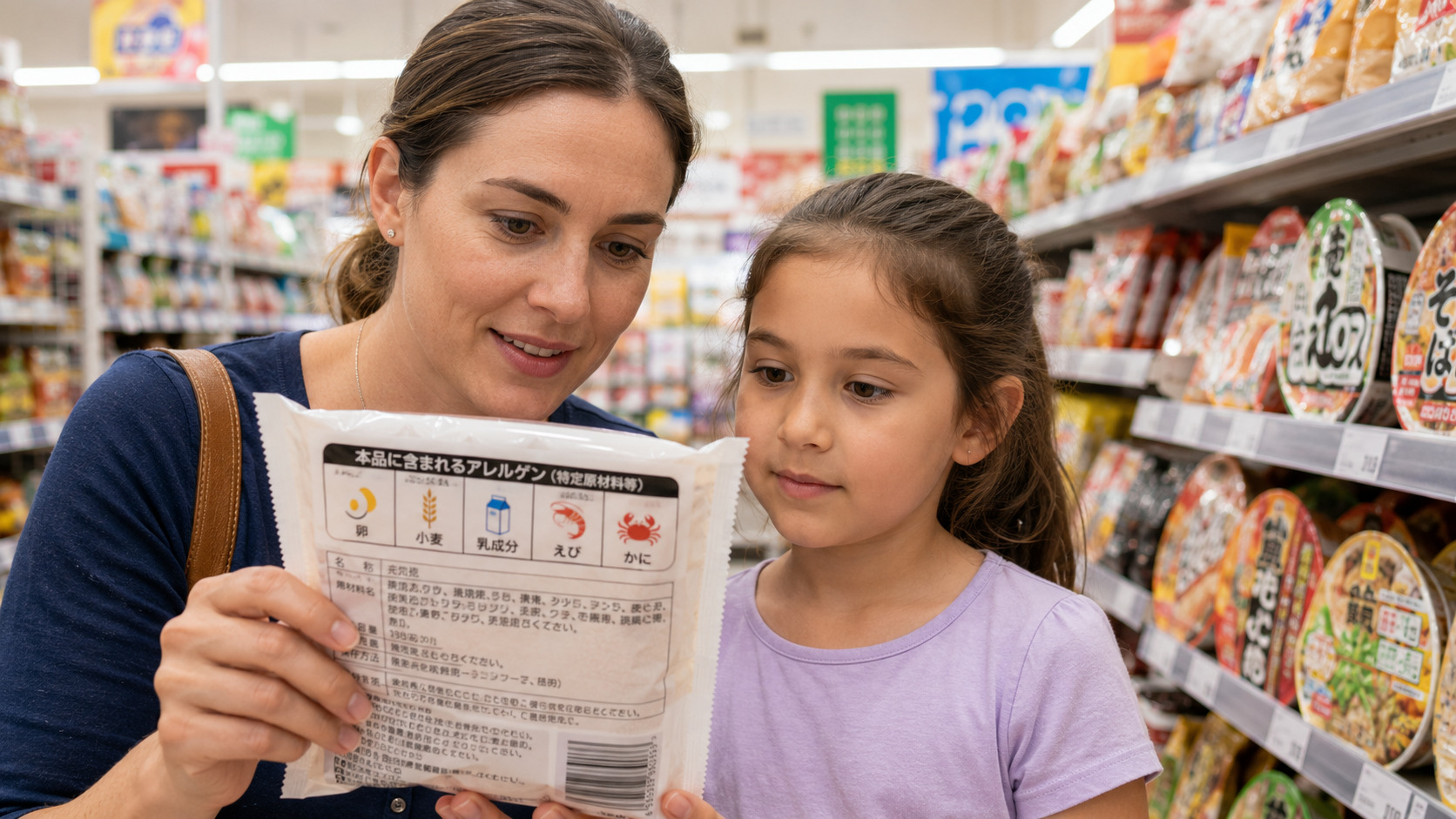
If you have a severe food allergy, please be careful in Japan. Many restaurants cannot guarantee complete allergen removal. Always inform the staff about your allergy and carry any necessary medicine, such as an EpiPen.
If you have trouble breathing or feel a strong reaction, call 119, the emergency number in Japan.
- How to Read Food Allergy Labels in Japan
- 1. Key Point: Learn the “8 Required” and “20 Recommended” Allergens
- 2. Why Labels Look Difficult
- 3. Required Allergens (8 Items) with Japanese Labels
- 4. Recommended Allergens (20 Items)
- 5. How to Read Allergy Labels on Packaged Food
- 6. Convenience Store Packaged Food Is Easy to Choose
- 7. Eating Out: What You Need to Know
- 8. Supermarket Deli and Bakery Items
- 9. Tips for Families and Long‑Stay Visitors
- 10. Okinawa‑Specific Allergy Notes
- 11. FAQ
- 12. Quiet Tip
- 13. Summary
How to Read Food Allergy Labels in Japan
A simple guide for first‑time visitors and families in Okinawa
1. Key Point: Learn the “8 Required” and “20 Recommended” Allergens
Japan has a clear food allergy labeling system. There are 8 required allergens and 20 recommended allergens. If you know these, choosing food becomes much easier.
For more details, see Japan’s Food Allergy Labeling System Explained.
2. Why Labels Look Difficult
- Many labels use Japanese and kanji
- But the rules are simple and unified
- Supermarkets, convenience stores, and restaurants show information differently
3. Required Allergens (8 Items) with Japanese Labels
These must be shown on all packages. The Japanese words below are what you will see on the label.
- Egg:卵 (Tamago)
- Milk:乳 (Nyuu)
- Wheat:小麦 (Komugi)
- Buckwheat:そば (Soba)
- Peanut:落花生 (Rakkasei) / ピーナッツ (Peanut)
- Shrimp:えび (Ebi)
- Crab:かに (Kani)
- Walnut:くるみ (Kurumi)
4. Recommended Allergens (20 Items)
These are often shown, but not always required:
- Almond
- Cashew nut
- Sesame
- Soy
- Chicken / Pork / Beef
- Salmon / Mackerel
- Banana / Kiwi / Peach / Apple … and more
5. How to Read Allergy Labels on Packaged Food
Common label styles
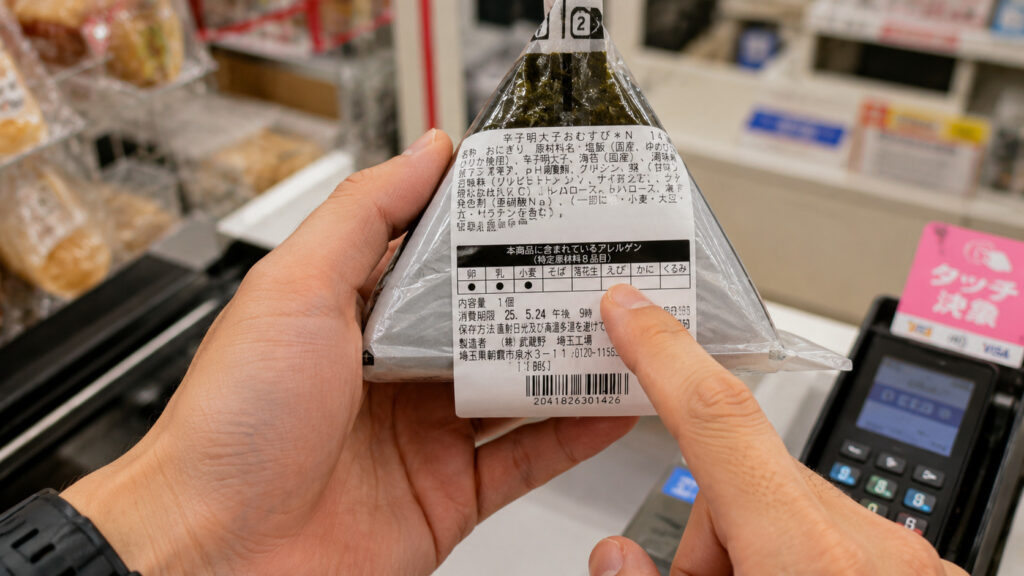
- “Contains egg, milk, wheat…” written in the ingredient list
- A separate allergy section
- “Made in a factory that also uses ○○” → This means possible cross‑contamination
Useful Japanese → English
- 卵を含む → Contains egg
- 小麦を含む → Contains wheat
- 乳成分を含む → Contains milk
- 大豆を含む → Contains soy
- 落花生を含む → Contains peanut
Tip: Take a photo and translate later
It is easier to take a photo of the package and translate it later at your hotel. This is safer than translating in a hurry inside the store.
Learn more in How to Translate Japanese Food Labels.
6. Convenience Store Packaged Food Is Easy to Choose
- Many packaged foods sold in convenience stores have clear allergy labels
- Some products include an allergen list or check table on the back
- The format varies by manufacturer, but checking the back of the package makes your choice much safer
- Seven‑Eleven, Lawson, and FamilyMart often have clear labels
7. Eating Out: What You Need to Know
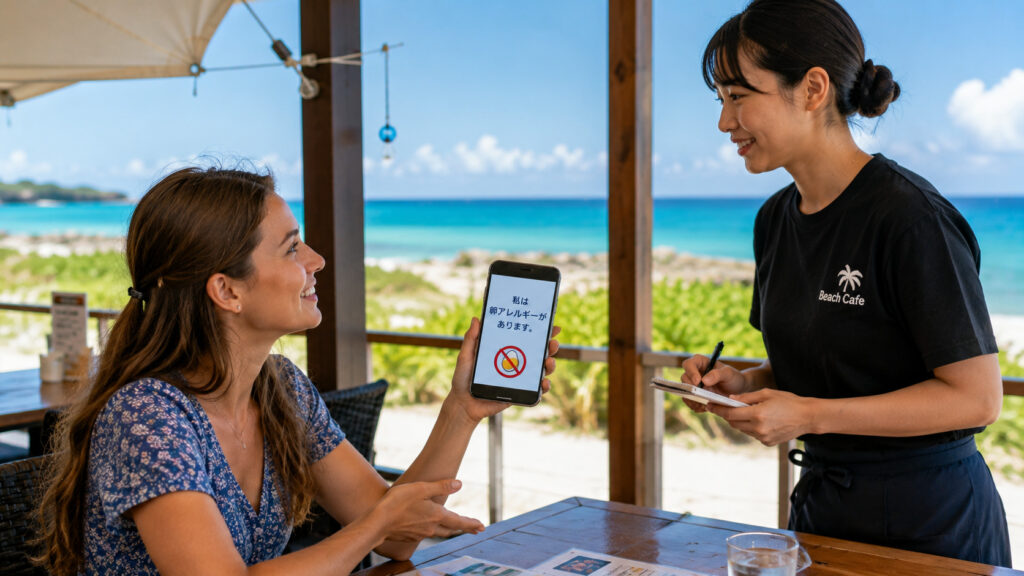
- Some restaurants show icons for allergens
- But many places cannot guarantee 100% allergen‑free meals
- Cross‑contamination is possible in shared kitchens
Useful English phrases
- I have a food allergy.
- Does this contain ○○?
- Is there a risk of cross‑contamination?
- Can you check the ingredients?
Best Method: Show an Allergy Card
Save this template on your phone. Fill in the [ ] with your allergen.
I have a severe [ Allergen ] allergy. 私は重度の[ 日本語のアレルゲン名 ]アレルギーがあります。
Even a small amount could cause a severe allergic reaction. 少量でも食べると命に関わることがあります。
Please check the ingredients before serving. 提供前に原材料をご確認ください。
Example: I have a severe Egg allergy. 私は重度の卵アレルギーがあります。 Even a small amount could cause a severe allergic reaction. 少量でも食べると命に関わることがあります。 Please check the ingredients before serving. 提供前に原材料をご確認ください。
Learn more in How to Make an Allergy Card in Japanese.
8. Supermarket Deli and Bakery Items
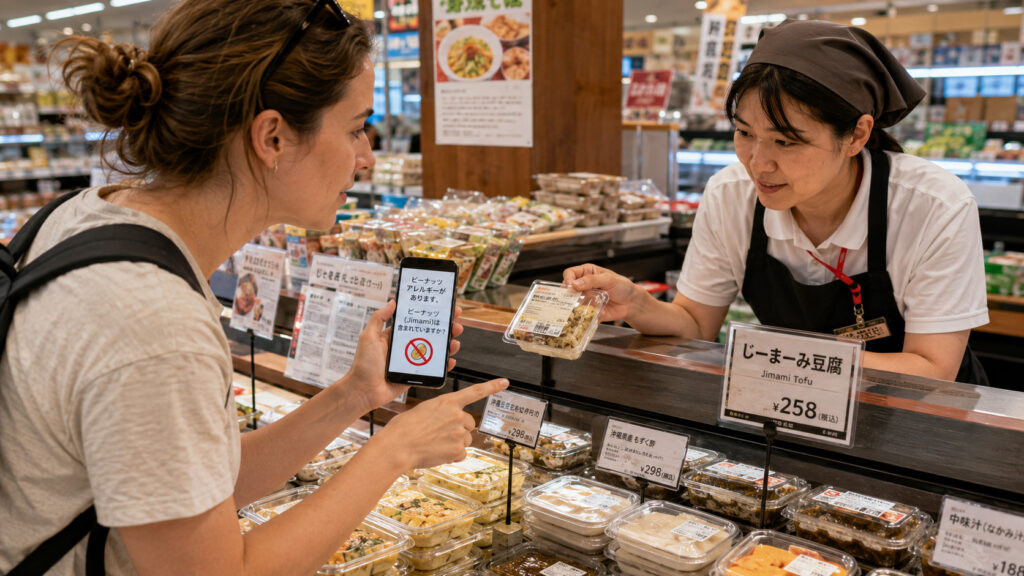
- These foods are cooked in the store
- Cross‑contamination risk is higher
- Bakeries often mix egg, milk, wheat, and nuts
- Ask the staff if you are unsure
9. Tips for Families and Long‑Stay Visitors
- Choose packaged food first because labels are clear
- Choose restaurants with allergy‑friendly menus
- Convenience store packaged food is easy to understand
- Buy the same “safe” items again during your trip
- Carry your allergy card and medicine
10. Okinawa‑Specific Allergy Notes
- Peanut tofu (Jimami Tofu) → contains peanuts
- Sata‑Andagi → contains egg and wheat
- Okinawa soba → contains wheat
- Many dishes use sesame
Important note for peanut allergies
Peanut tofu in Okinawa is written as Jimami Tofu (じーまーみ豆腐). “Jimami” means peanut in the Okinawan language. If you have a peanut allergy, avoid anything with the word Jimami.
Learn more in Okinawa Food Allergen Guide.
11. FAQ
Q. Can I bring my EpiPen to Japan? Yes. You can carry it on the plane.
Q. Can I ask convenience store staff about allergens? Yes. But checking the package label is the most accurate way.
Q. What if I cannot read Japanese? Take a photo of the package and translate it later in a quiet place.
Q. Is a translation app enough? It helps, but using a Japanese allergy card is safer.
Q. Do restaurants have allergy information in English? Some do, but many do not.
Q. Can restaurants remove allergens? Many cannot guarantee complete removal.
Q. What does “may contain” look like in Japan? It is often written as “Made in a factory that also uses ○○.”
Q. What if I am not sure whether a food is safe? If you are not sure, do not eat it. Choose another food or ask the staff. Staff in Japan are usually kind and will try to help you.
12. Quiet Tip
You may want to try many new foods during your trip. But if you have food allergies, choosing foods you already know are safe is also a good way to enjoy Okinawa.
13. Summary
- Japan uses “8 required + 20 recommended” allergens
- Packaged food in convenience stores is easy to understand
- Packaged food is the safest choice
- Restaurants cannot guarantee complete allergen removal
- Use the allergy card template
- Be careful with Okinawa‑specific foods
- Families and long‑stay visitors can travel safely with the right tips
Related Guides
👉 Okinawa Travel Guide for First-Time Visitors
👉 Do You Need a Car in Okinawa? (A Local’s Honest Advice)
👉 How Much Time Do You Need in Okinawa?
👉 Why Your Last Day in Okinawa Feels Better With Extra Airport Time
コメント