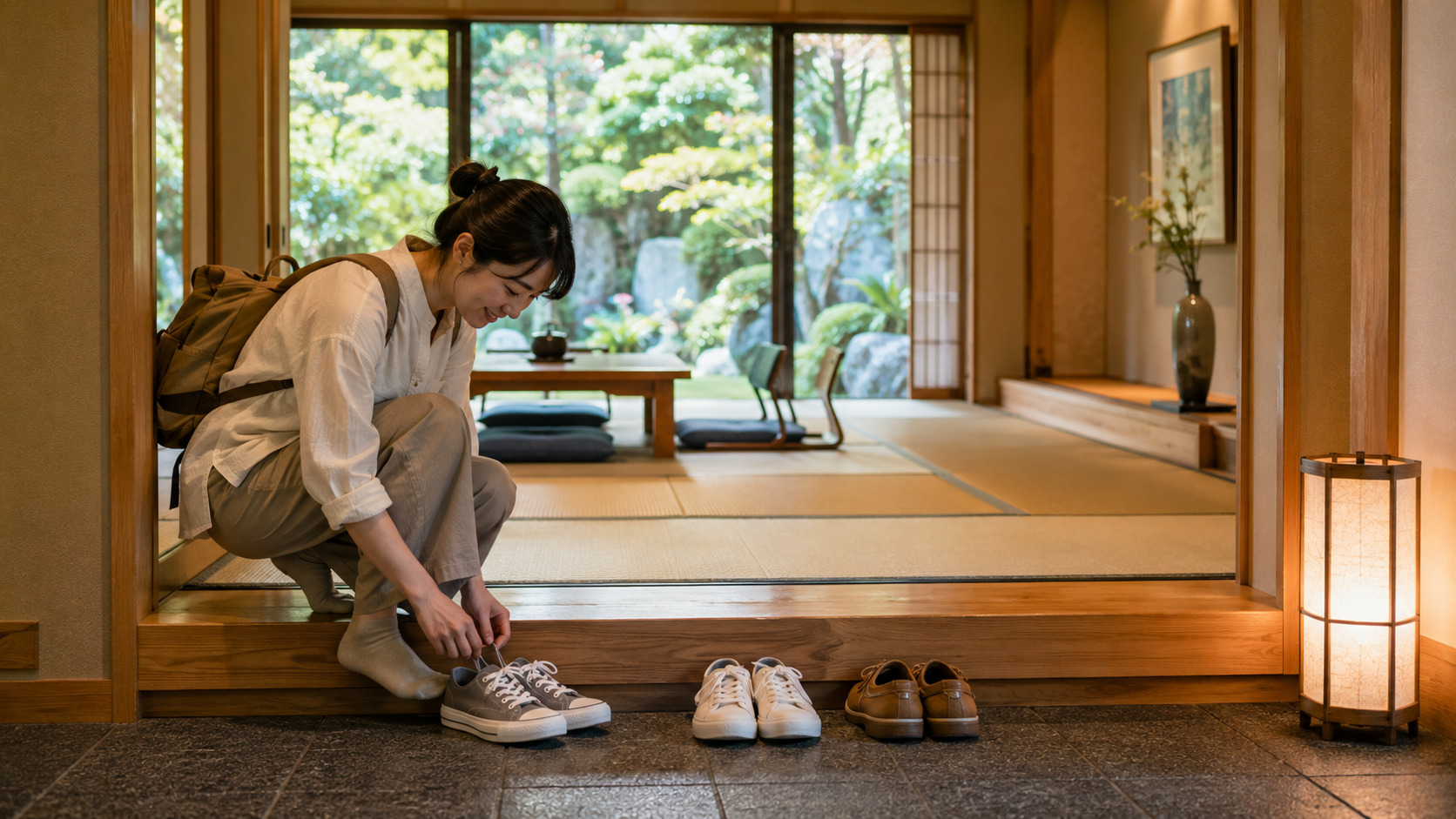
A Simple Guide for First-Time Travelers
- Introduction
- Quick Answer (5-Second Guide)
- Why Japanese Hotels Ask You to Remove Your Shoes
- How to Know When to Take Off Your Shoes
- Where to Put Your Shoes
- The Slipper Rule (Very Important)
- Toilet Slippers (Common Culture Shock)
- Suitcases and Tatami
- Wet Shoes and Beach Sand (Okinawa Tips)
- Kids and Floor Culture
- Can I Wear Slippers in the Hallway?
- Common Mistakes Travelers Make
- Okinawa Tips (Local Information)
- Useful Phrases
- Quiet Tip
- FAQ
- Summary
Introduction
Many first-time visitors to Japan are surprised when hotels ask them to take off their shoes. This rule is different from hotels in many other countries.
But once you know the reason, it becomes easy to understand. This guide explains what to do, why it matters, and how to avoid mistakes.
Let’s start with a quick answer.
Quick Answer (5-Second Guide)
- Tatami room → Always take off your shoes
- Entrance area → Take off your shoes
- Slippers provided → Usually take off your shoes
- No entrance step, no floor change, and no shoe-removal sign → Shoes may be OK
- If you are not sure, ask: “Should I take off my shoes here?”
Why Japanese Hotels Ask You to Remove Your Shoes
Cleanliness
Japanese people try to keep indoor spaces clean. They do not bring dirt from outside into the room.
Clear Line Between “Outside” and “Inside”
In Japan, “outside = dirty” and “inside = clean.” A hotel room is treated like a home.
Protecting Tatami
Tatami is soft and easy to damage. It is made for bare feet or socks, not shoes.
How to Know When to Take Off Your Shoes
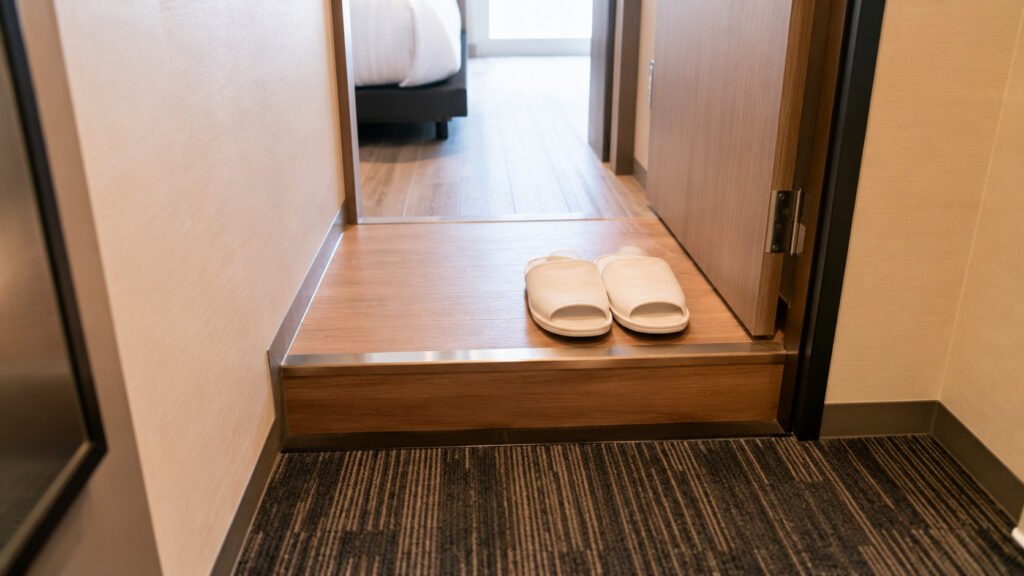
1. Look for Floor Changes or Stickers
- A sticker saying “Please take off your shoes here”
- A clear line where the floor changes color or material
In many Japanese business hotels, only the first 1 meter near the door is the “shoe area.”
Even if the whole room has carpet, look for a small line or step on the floor as soon as you open the door.
The floor often tells you the rule before any sign does.
2. Entrance Area → Take off your shoes
3. Slippers Provided → Take off your shoes
4. Tatami Room → Always take off your shoes
5. No entrance step, no floor change, and no shoe-removal sign → Shoes may be OK
6. If unsure → Ask the staff
When to Take Off Your Shoes
Take off your shoes right at the entrance area. Do not walk inside and then remove them.
Where to Put Your Shoes
- Place them neatly in the entrance area
- Use the shoe rack if the room has one
- Do not put shoes outside in the hallway (it blocks the path)
Some travelers confuse this with European hotels where shoes are left outside for cleaning. In Japan, this is not done.
The Slipper Rule (Very Important)
- In most hotels, room slippers are only for inside your room.
- Do not wear them in the hallway, elevator, lobby, or breakfast area
- Exception: Hotels with hot springs or public baths
- Reason: Room slippers help keep the room clean
How to Know If Slippers Are OK for Walking Inside the Hotel
If your room has these items, slippers are often OK for indoor walking:
- Thick brown or black slippers
- Washable sandals or geta
- A yukata, jinbei, or samue (indoor clothes)
Toilet Slippers (Common Culture Shock)
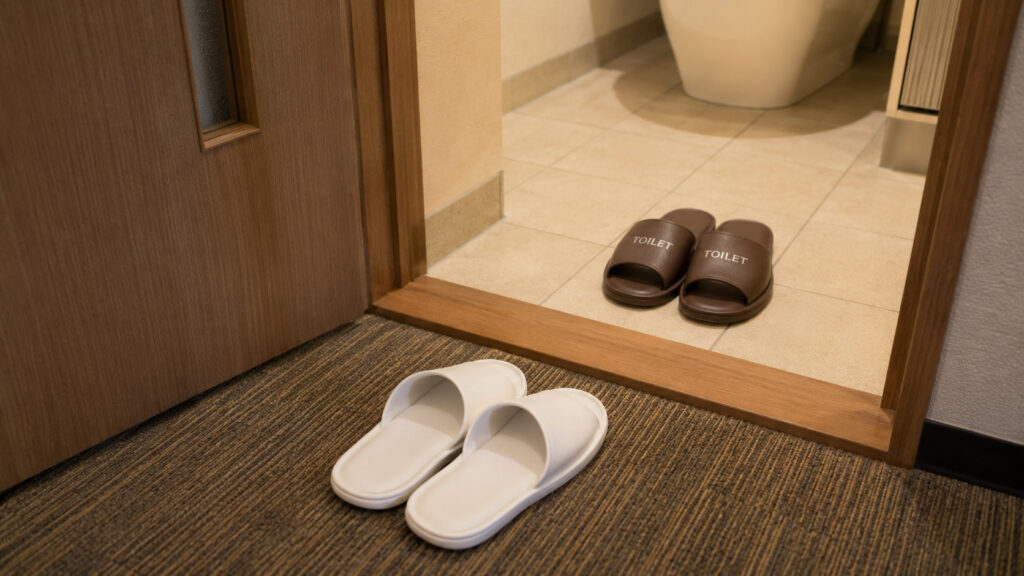
Some hotels and ryokan have special slippers only for the toilet.
- Use them only inside the toilet
- Do not walk back into the room with them!
- For many Japanese people, seeing toilet slippers on tatami feels very unhygienic.
- Many Japanese people also forget to change them back sometimes, so do not worry too much.
Suitcases and Tatami
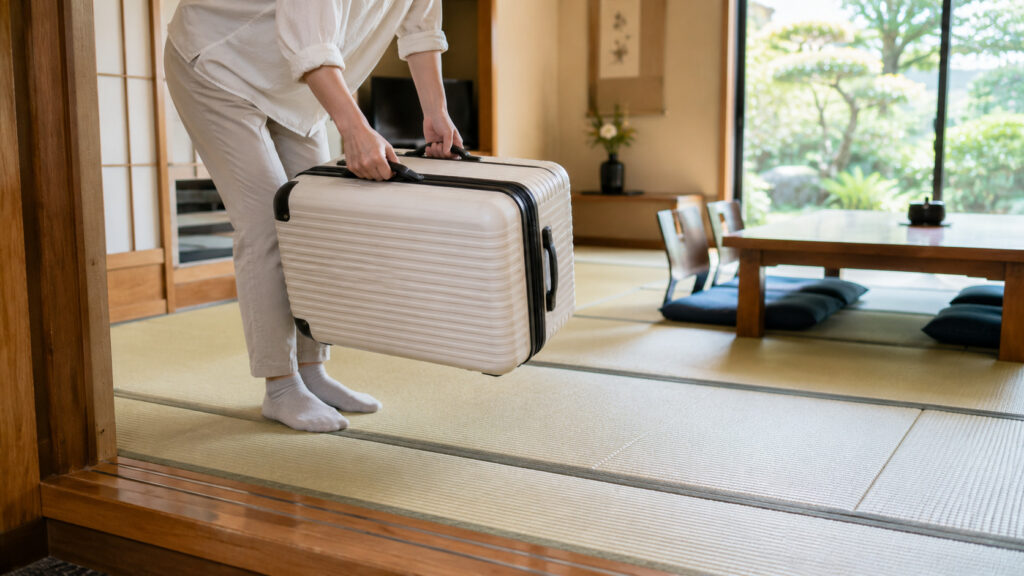
- Do not roll suitcase wheels on tatami
- Keep your suitcase near the entrance
- Tatami can be damaged easily
- If you need to open your suitcase, do it on the wooden or tile floor, not on tatami.
Wet Shoes and Beach Sand (Okinawa Tips)
- After the beach, your shoes may be wet or sandy
- Take them off at the entrance
- Many Okinawa hotels have a “foot shower” (sand-washing area) near the beach entrance
- Please wash away all sand before going back to your room
Kids and Floor Culture
In Japan, the floor is part of daily life. Kids play and crawl on the floor. This is why keeping the floor clean is very important.
Can I Wear Slippers in the Hallway?
- Usually no
- Some hotels have special indoor slippers for walking around
- Check hotel rules to be safe
Common Mistakes Travelers Make
- Walking onto tatami with shoes
- Wearing toilet slippers back into the room
- Rolling suitcase wheels on tatami
- Wearing beach sandals inside the room
- Forgetting to remove shoes at the entrance
- Wearing room slippers in the hallway
- Leaving shoes outside the door (it may block the hallway)
Okinawa Tips (Local Information)
- Some hotels offer “shima-zori” (Okinawan beach sandals)
- Some are free to take, some are reused
- Check the room card for details
- Okinawa resort hotels often have more amenities than business hotels
- Check the information card when you enter the room
Useful Phrases
- “Should I take off my shoes here?”
- “Is it OK to wear shoes inside this room?”
- “Do I use slippers in this area?”
- “Where should I leave my shoes?”
Quiet Tip
Taking off your shoes is a small habit, but it helps you experience everyday life in Japan just like local people do.
FAQ
Q. Can I walk barefoot instead of using slippers? → Yes. Bare feet or socks are fine unless the hotel says otherwise.
Q. Where should I put my shoes? → In the entrance area or on the shoe rack.
Q. Can I wear slippers in the hallway? → Usually no. Check the hotel rules.
Q. Do I always remove shoes in tatami rooms? → Yes. Always.
Summary
- Japanese hotels ask you to remove shoes for cleanliness, culture, and tatami
- Follow the order: Tatami → Entrance → Slippers → Western-style exceptions
- Be careful with slippers, toilet slippers, sand, and suitcases
- Ask if you are not sure
- Removing your shoes helps you enjoy a quiet and comfortable stay
- Once you know this simple rule, staying in Japanese hotels becomes much more comfortable.
Related Guides
👉 Okinawa Travel Guide for First-Time Visitors
👉 Do You Need a Car in Okinawa? (A Local’s Honest Advice)
👉 How Much Time Do You Need in Okinawa?
👉 Why Your Last Day in Okinawa Feels Better With Extra Airport Time

コメント