‘t have the final answer yet, but after living in Nago and watching the same mountain every day, I’ve started noticing a pattern that might help travelers enjoy Okinawa’s viewpoints even more.
Have you ever stood at a viewpoint like Kouri Bridge, Cape Hedo, or Nago Castle Park and thought, “I can’t see as far as I expected”? The sky looks clear, but the horizon or distant islands seem blurry. Your photos might even look a little white and washed out. Many travelers have this experience without knowing why.
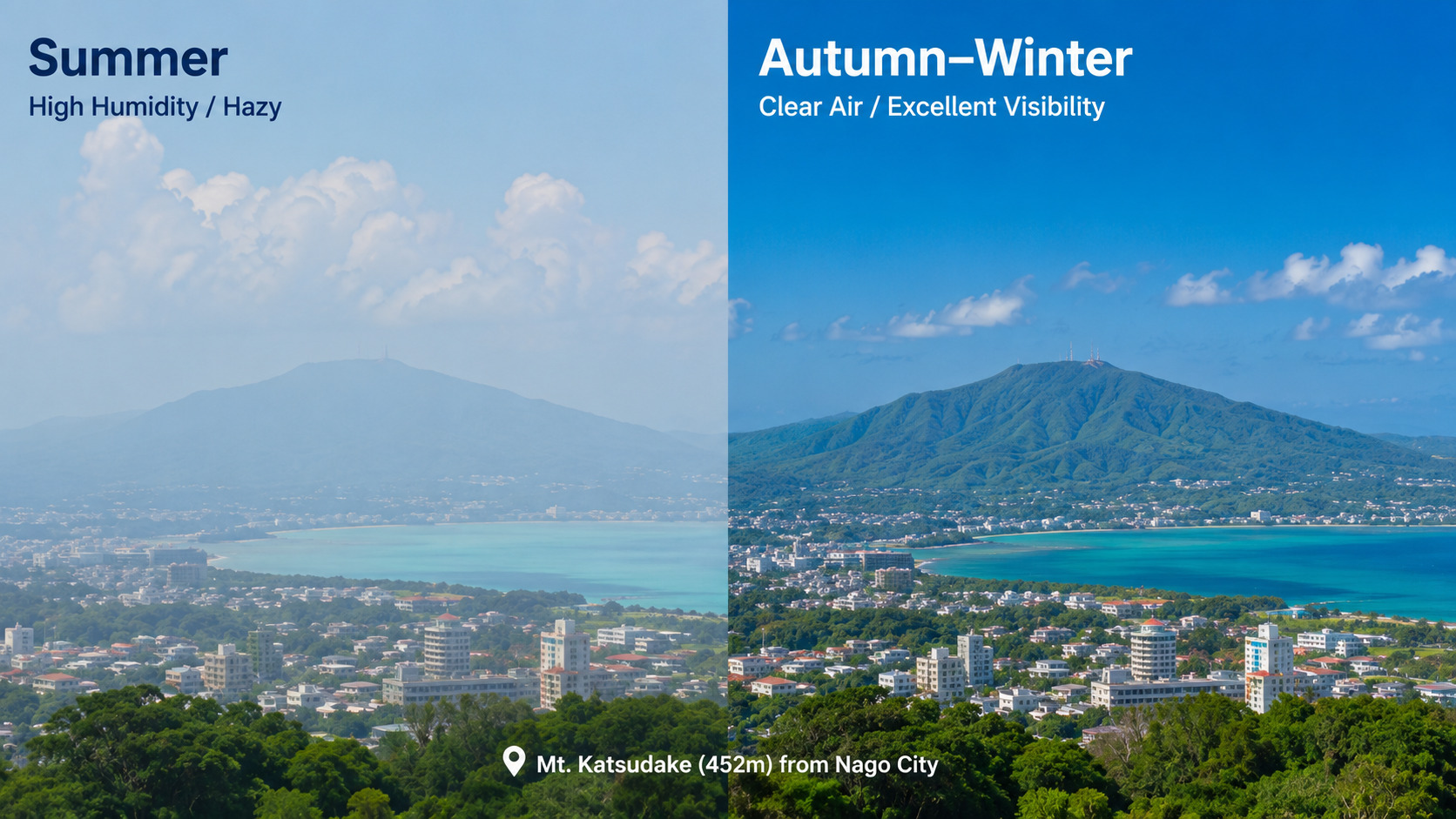
I live in Nago, and I see something similar almost every morning. From my house, I can see Mt. Katsu-u. In summer, the top of the mountain often looks hazy.
Mt. Katsu-u stands northwest of central Nago. It is 452 meters tall (about 1,480 feet). But the view from the top is not always clear. It seems to change quite a bit with the seasons.
Humidity Data: How Each Season Is Different
Let’s look at Nago’s average humidity by month, based on Japan Meteorological Agency data.
- Jan – Mar: 73–75% — Lower humidity, but yellow dust from the continent can affect the air
- Jun (peak): 84% — The highest humidity of the year
- Jul – Aug (feels hottest): About 80% — Still humid, but slightly lower than June
- Oct – Dec (lowest): 71–73% — The lowest humidity of the year. I’m currently watching to see if this means clearer views
Here’s something interesting. Many people feel July and August are the most humid months. But the humidity numbers show June (the rainy season) is actually the peak. What we feel and what the data show are not always the same.
These numbers made me wonder whether the hazy views I see each summer are connected to seasonal humidity.
Of course, humidity alone doesn’t decide how clear the view will be. But it’s a useful clue when thinking about air clarity.
Why High Humidity Makes Views Look Hazy
I started wondering why this happens, and the answer isn’t unique to Okinawa. It’s a common weather pattern. When the air holds more water vapor, light scatters more easily off water droplets and tiny particles. It can feel almost like looking through a very light mist in the air. Because of this, distant views often look blurry and pale white.
This effect is especially common during Okinawa’s humid summer months. In drier months, light scatters less. Distant views can look clearer and sharper.
Humidity Isn’t the Only Factor
Here’s one important thing to keep in mind. Low humidity doesn’t always mean a clear view.
For example, in early spring (March–April), humidity is often lower, but yellow dust or fine particles (PM2.5) from the continent can still make the air look hazy. On the other hand, right after a typhoon, humidity can be high, but strong winds may clear the air and views can be surprisingly sharp.
So we can’t simply say “autumn and winter are always better.” Humidity is just one factor among several.
A Few Tips for Travelers
While my own observations are still ongoing, these general conditions are well known for improving visibility.
To sum up, distant views tend to be clearer under conditions like these:
- It’s early morning (as the day warms up, rising air can make distant views look less clear)
- It’s just after rain (rain can wash dust and particles out of the air, making views clearer)
- Strong wind has recently cleared the air
If you’re planning to visit a viewpoint, early morning or right after rain may give you a clearer view.
One more tip: try taking photos with the sun behind you whenever possible. This usually reduces haze in photos and makes the blue of the ocean and mountains look richer. Facing toward the sun often makes photos look pale and washed out, because sunlight reflects off the moisture in the air.
This Observation Has Just Begun
To be honest, this article isn’t a final conclusion yet. I’ve actually been watching this mountain almost every morning for about a year. But until now, I never photographed it — I was just watching. Starting this month, I’m photographing Mt. Katsu-u from the same spot and angle, so I can properly compare how it looks across the seasons.
This might not stop with Mt. Katsu-u. Northern Okinawa has many places where the view likely changes with the seasons — Nago Castle Park, Kouri Bridge, Cape Hedo, and Arashiyama Observatory, to name a few. I’d like to continue this kind of observation at each of these spots.
Summer in Okinawa is wonderful, too. But if you visit in autumn or winter, take a moment to notice how the same view can look different.
Instead of asking “Which season is best?”, I’m beginning to ask a different question: “How does the same place change through the seasons?” That small question has made me look at Okinawa a little differently. I’ll keep watching, taking photos from the same places, and sharing what I discover along the way.
Related Guides
👉 Okinawa Travel Guide for First-Time Visitors
👉 Do You Need a Car in Okinawa? (A Local’s Honest Advice)
👉 How Much Time Do You Need in Okinawa?
👉 Why Your Last Day in Okinawa Feels Better With Extra Airport Time

コメント